Processing at the edge. Data inside the border
Mini mesh networks that keep data sovereign and systems interoperable. Built for next-generation environments, they process at the edge and cut latency.
AI-enhanced mesh data centers
Mini mesh data centers, also called edge data centers, are small-scale facilities built for remote and distributed sites. Unlike hyperscale data centers, which span vast footprints and draw enormous power, these are compact, energy-efficient and adaptable, housed in containers or small buildings, from a few racks to several kilowatts. AI turns them from boxes into decision-makers: they process in real time, decide locally, and keep working when the line to the centre is slow, contested or gone.
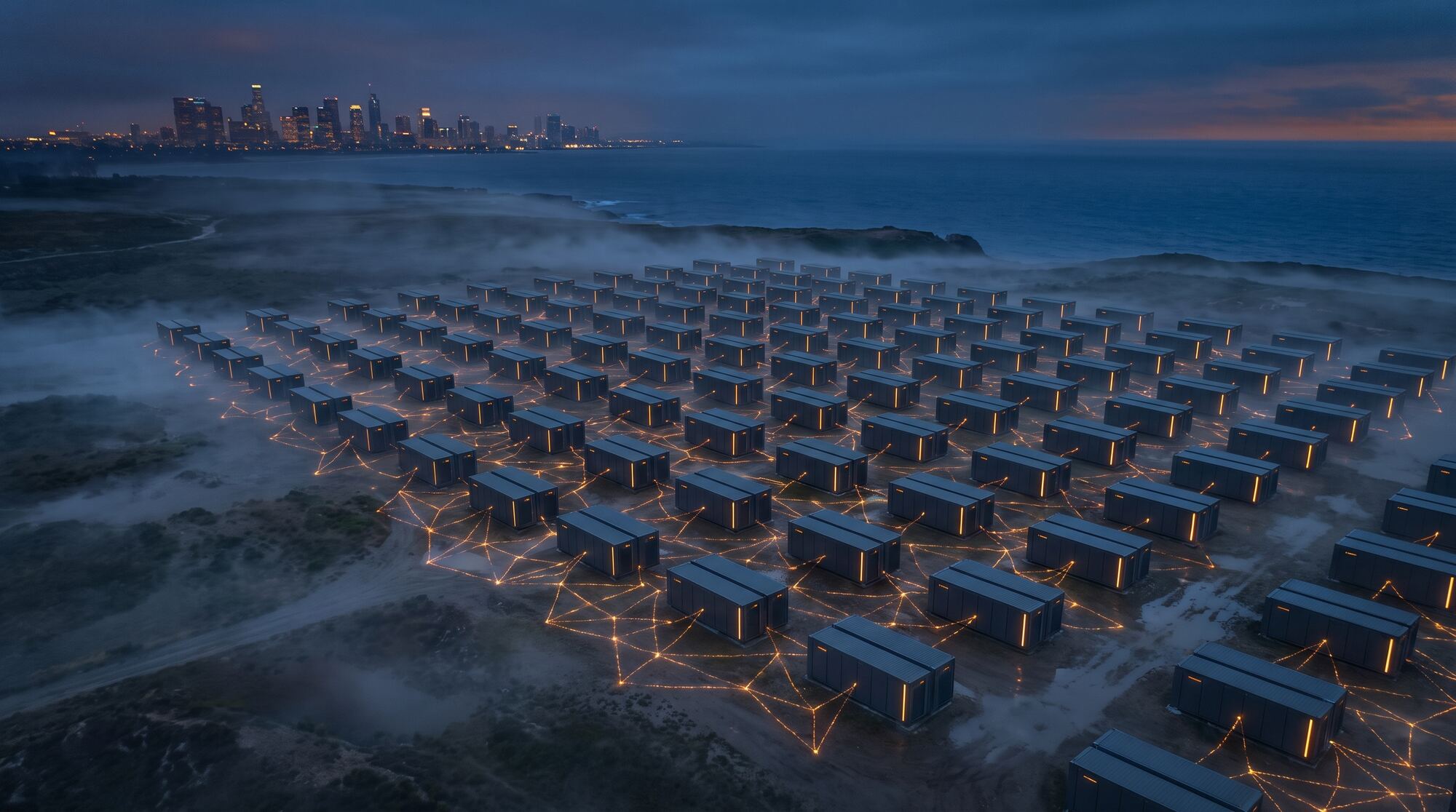 Mesh pods · coastal edge grid
What it changes
on the ground.
Latency
Decisions happen where the data lands, not after a round trip to a central cloud.
Sovereignty
Data stays on national ground, under national rules, in every next-generation environment.
Resilience
A mesh has no single point of failure. Each node carries the load of the next.
Three forces pull
compute to the edge.
Edge computing demands
As IoT devices proliferate, processing at the source is what keeps autonomous systems and real-time monitoring fast.
AI workload growth
Generative AI and machine learning need distributed inference and training, not the cloud alone.
Sustainability and efficiency
Compact designs use less energy, and AI optimises resource allocation to lower operating cost.
A mesh of nodes,
each one intelligent.
Compact, modular deployments in a networked mesh of edge nodes rather than centralised hubs.
Distributed processing
Interconnected nodes scale horizontally. Each handles AI tasks on its own and collaborates on complex workloads.
Real-time AI deployment
Models embedded at the edge give instant insight from live data streams: machine learning for prediction, and large language models for automation.
One platform as a service
A single platform connecting data across clouds, on-premises systems, partner ecosystems and edge environments, so an AI workflow runs the same wherever it lands.
The Edge AI hub and marketplace
Pre-validated models reach every node through AI Xchange, so a new capability is a deployment rather than a programme.
Data unification
SQL, NoSQL, unstructured, time series, vector, geospatial and sensor data in one view, with streaming analytics.
Quantum processing support
Quantum processing units for the computationally intensive AI work a mini deployment could not otherwise carry.
Intelligent interoperability
Legacy and modern systems bridged, so each mini data center joins the estate it sits in.
Where the mini data center
becomes a strategic asset.
Healthcare and life sciences
Edge AI for predictive patient monitoring, with device data integrated for real-time health insight.
Manufacturing
Smart factories with IoT-connected mini data centers for predictive maintenance and energy optimisation.
Financial services
Dynamic risk management and personalised products at low latency.
Public sector
Cross-agency data sharing in modular setups for better public services and health management.
Energy and utilities
Distribution optimised with sensor-integrated mini centers, for compliance and efficiency.
Retail
Omni-channel experiences synchronised through edge AI reading sales data in real time.
The business case,
in four lines.
Cost savings
Legacy investment is preserved and energy use optimised, so the high cost of replacement never arrives.
Innovation
Real-time insight at the edge drives predictive maintenance, personalised services and efficient supply chains.
Resilience
A distributed architecture has no single point of failure, so operations continue when one node does not.
Sector gains
Smart factories in manufacturing, predictive analytics in healthcare, grid optimisation in energy.
Data unified, AI embedded at the edge and interoperability across the estate: mini data centers powered by the Mini Mesh AI Edge architecture are a pathway to agile, efficient and innovative computing.
Where it applies.
Sectors this layer carries most of the weight in.
The future
is connected.
Bring us the system nobody could connect.
Request a briefing